
TL;DR

Get decor and gifts delivered free with Prime
- Fast, free delivery on millions of items
- Prime Video, Amazon Music and more included
- Member-only deals all year
Hunker reported on a toilet paper holder DIY by YouTube creator Kelly Barlow that repurposes a wire clothes hanger and its cardboard bar. The project uses twine, glue and optional decorations; the report does not provide independent testing, cost estimates or durability details.
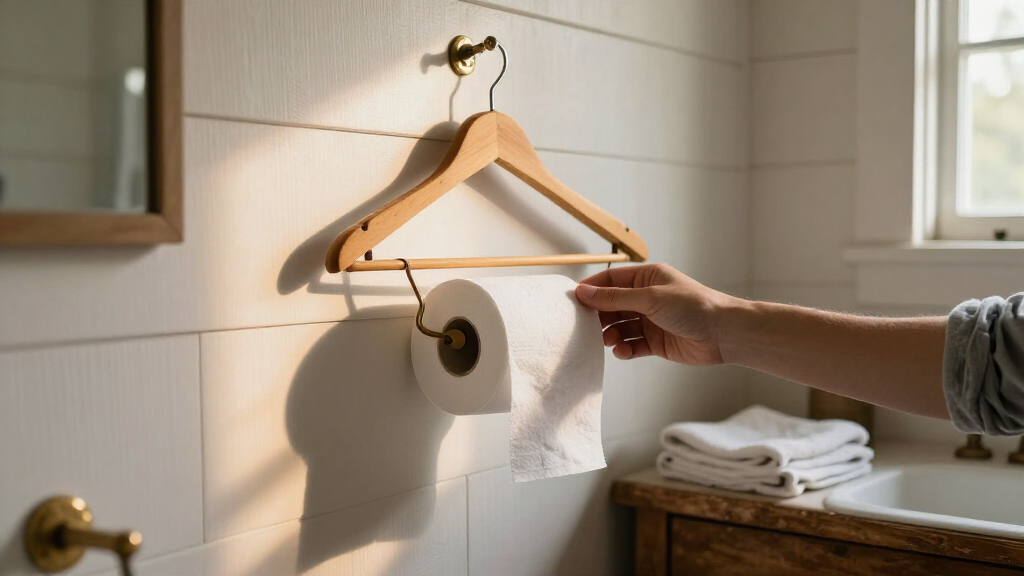
Hunker has featured a DIY toilet paper holder by YouTube creator Kelly Barlow, who repurposes a wire clothes hanger and its cardboard crossbar into a dispenser decorated with twine and burlap. The project offers a way to reuse a common household item, but its appeal and suitability depend on the materials, the holder’s stability and a bathroom’s style.
Barlow’s project uses a hanger with a removable cardboard tube along its lower bar, which she reuses as the spindle for the toilet paper roll. Other listed supplies include flat- or needle-nose pliers, wire cutters, a ruler, a marker, tape, twine, hot glue, burlap ribbon and scissors. Ink and faux flowers or greenery are optional decorative additions.
In the steps described by Hunker, Barlow removes the tube, cuts away the wire ends that had fitted inside it, and trims the hanger wire near the bends below its neck. She tapes the shortened wire pieces back to the hanger’s lower section and cuts the cardboard tube to fit between them. Twine is then wrapped around the wire and tube and attached with hot glue.
The finished piece can be customized or left plain. Hunker says Barlow adds distress ink to the twine and decorates the holder with a burlap bow, a faux sunflower and greenery. The report also suggests alternatives such as colorful yarn, coordinating ribbon or beads, but provides no tested measurements beyond the instruction to measure five inches from each bend near the hanger’s neck before cutting.
A Second Use for Wire Hangers
The project is a small-scale reuse idea for wire hangers that might otherwise be discarded. It also turns a functional bathroom item into a visible decorative accent, potentially giving readers a low-material way to match a rustic or handmade look without buying a conventional holder.
Its practical value is not established by the report. Hunker does not give a price comparison, test the holder’s weight capacity, or report how well the cardboard spindle holds up to repeated use in a bathroom. Readers should treat the design as a craft suggestion rather than a verified replacement for commercially made bathroom hardware.
Products Worth Considering

Ring Battery Doorbell (1st Gen), 2-Pack, Satin Nickel

Blueair Blue Pure 511i Max Air Purifier for Home and Bedroom

Levoit Eleva 300X HEPA Air Purifier
As an affiliate, we earn on qualifying purchases.
How the Hanger Becomes a Dispenser
The idea combines the hanger’s existing shape with its lower cardboard bar: the hanger forms the support, while the tube becomes the roll’s axle. Twine and hot glue cover and hold the components together, and burlap or faux foliage supplies the rustic finish. The source describes a project tutorial by Barlow, rather than a product launch or formal home-improvement test.
Hunker also notes that not every wire hanger has the removable cardboard tube used in Barlow’s version. The instructions are therefore most directly suited to hangers with that feature. The report mentions other toilet-paper storage DIY projects as possible companions but gives no further design details in the supplied material.
““It works especially well if your wire hanger has a removable cardboard tube along the bottom””
— Hunker, describing the hanger used in the tutorial
Durability and Fit Are Untested
The supplied report does not establish how securely the holder mounts, whether it can support different toilet paper roll sizes, or how the cardboard tube and glued twine respond to moisture and regular handling. It gives no test results, long-term use account or measured cost. It is also unclear whether every hanger can be shaped as shown; the tutorial specifically favors one with a removable cardboard bar.
Hunker warns readers to wear safety glasses when cutting wire because it can fly, and to use wire cutters or pliers with a cutter while keeping a steady grip. The source does not describe a wall-mounting method. Anyone adapting the craft should avoid sharp exposed wire and check that the finished holder is stable and safely positioned before use.
Check the Hanger Before Cutting
For anyone considering the project, the first step is to check whether the hanger has a removable cardboard tube and gather the listed tools before cutting. Follow the source’s safety advice: wear safety glasses, use appropriate wire-cutting tools and keep control of the wire as it is cut. The report offers no announced follow-up, product release or testing schedule; any further evaluation would depend on users trying the design and reporting how it performs.
Key Questions
What is the DIY toilet paper holder made from?
It uses a wire clothes hanger, preferably one with a removable cardboard tube, along with twine, tape and hot glue. Burlap ribbon and faux flowers or greenery are optional decorations.
Does the project work with every wire hanger?
The report says the design works especially well with a hanger that has a removable cardboard tube along its bottom. It does not confirm that all hanger styles can be adapted in the same way.
What safety precautions does the source recommend?
Hunker advises wearing safety glasses when cutting wire, using pliers with a built-in cutter or dedicated wire cutters, and keeping a firm, steady grip on the tool.
Is the finished holder proven to be durable?
No durability testing is included in the supplied report. It does not state how the cardboard spindle or glued covering holds up to bathroom moisture or repeated use.
Source: rss