TL;DR

Get decor and gifts delivered free with Prime
- Fast, free delivery on millions of items
- Prime Video, Amazon Music and more included
- Member-only deals all year
A House Beautiful retrospective charts wallpaper styles from the 1940s through the 2020s, connecting each decade with recurring design trends. The report describes today’s popular looks as including maximalist florals, botanical prints, murals and textured wallcoverings, while noting that the 2020s are still underway.
House Beautiful has published a retrospective tracing wallpaper styles from the 1940s through the 2020s, showing how wallcoverings have shifted from postwar florals and midcentury novelty prints to today’s botanical designs, murals and textured finishes. The magazine cautions that the current decade is still in progress, so its description of 2020s wallpaper reflects trends visible so far rather than a settled historical style.
The report draws on examples featured in past issues of House Beautiful, linking design choices to the periods in which they appeared. In the early 1940s, the magazine says, wartime conditions were accompanied by more subdued wallpaper colors. The second half of the decade brought brighter palettes, bold florals and geometric designs, mixing traditional and modern motifs.
In the 1950s, wallpaper remained busy and colorful, with whimsical novelty patterns such as boomerangs, aquariums and kitchen utensils alongside pastel hues and floral bouquets. The 1960s brought mod-inspired graphics: geometric forms, graphic florals and contrasting oranges, browns and greens. The report also points to psychedelic swirls and experimental abstract designs from the period.
The 1970s amplified those strong patterns, with larger, more detailed repeats and psychedelic geometry. Wallcoverings also included tactile materials such as vinyl and grasscloth. The 1980s favored dramatic rooms, chintz and prairie-style florals, while Memphis Group-inspired abstract designs offered a brighter alternative. In the 1990s, the magazine identifies a move toward softer colors, simple patterns and country-cottage or romantic styles, including subtle florals and renewed interest in damask.
How Wallpaper Reflects Each Era
The timeline offers readers a way to connect interior design choices with changing tastes, rather than treating wallpaper as a purely decorative detail. Across the examples, patterns and materials move between bold display and quieter backdrops: the report’s 1970s and 1980s rooms use wallpaper as a major visual statement, while its 1990s examples favor lighter, more restrained schemes.
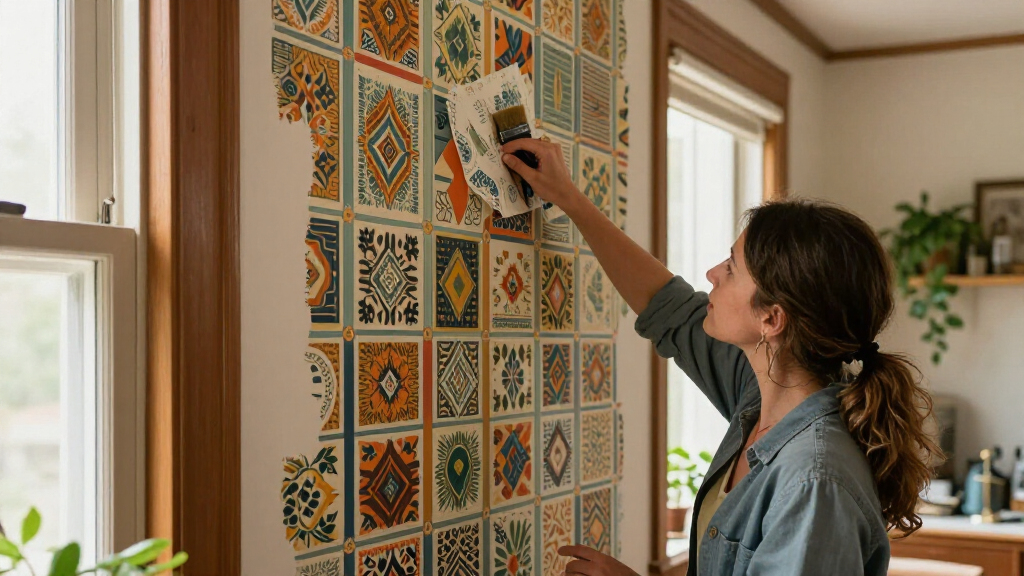
It also highlights how practical changes can affect who uses wallpaper. House Beautiful points to peel-and-stick products in the 2010s as an option that made the design element more accessible to renters and do-it-yourself decorators. The retrospective is not a market survey, but it gives readers a concise reference for recognizing styles that recur in homes and design coverage.
As an affiliate, we earn on qualifying purchases.
From Traditional Prints to Murals
The report’s later decades show both continuity and change. In the 2000s, shabby-chic florals and traditional motifs such as toile appeared alongside brighter, computer-designed abstract patterns. The magazine describes the decade as varied, with styles at its beginning differing from those near its end.
For the 2010s, House Beautiful points to trompe l’oeil effects, textured finishes and minimalist geometry, including chevron. Its example of a neutral grasscloth-covered stairway illustrates the continuing appeal of texture. In the 2020s, the report identifies oversized florals, richly colored botanicals and immersive wallpaper murals, while suggesting that grasscloth remains in use.
The article uses selected rooms and archived magazine issues to illustrate its chronology, including examples from 1946, 1954, 1962, 1974, 1982, 1994, 2006 and 2014. Those examples establish what the publication chose to feature; they do not, by themselves, measure how common a style was across all homes.
“We’re only just over halfway through the 2020 decade, so it’s not possible to say for certain what wallpaper styles will come to epitomize this era.”
— House Beautiful
The 2020s Are Still Unfolding
The report does not establish how widely each style was adopted, or rank trends using sales, survey or market data. Its account is a visual retrospective based on selected magazine examples, so terms such as “popular” describe the publication’s design overview rather than a measured share of households.
It is also too early to determine which looks will define the 2020s in retrospect. House Beautiful identifies botanicals, maximalism, murals and texture as visible tendencies, but the decade has not ended and its lasting signature remains uncertain.
How Current Trends May Develop
No future milestone or forecast is provided in the source report. The next meaningful step in judging the decade’s wallpaper legacy will come with time: later design coverage and a fuller view of the 2020s may show whether today’s botanical prints, murals and textured wallcoverings remain defining choices or give way to other styles.
For now, readers can use the retrospective as a guide to the examples and trends House Beautiful has documented, while treating its account of the current decade as provisional rather than a final verdict.
Key Questions
What wallpaper styles does the report associate with the 1940s?
House Beautiful describes subdued tones in the early 1940s, followed later in the decade by bold florals, brighter colors and geometric patterns that blended traditional and modern motifs.
What wallpaper trends does House Beautiful identify in the 1970s?
The report points to large-scale, detailed patterns, repeated geometric designs and stronger psychedelic influences. Textured materials such as vinyl and grasscloth also appeared.
What wallpaper styles are associated with the 2020s so far?
House Beautiful highlights oversized florals, richly colored botanical designs, wallpaper murals and texture. It says the decade is still underway, so these are current observations rather than a final account.
Did wallpaper become easier for renters to use?
The report says peel-and-stick wallpaper became an option in the 2010s, making wallpaper more accessible to renters and do-it-yourself decorators. It does not provide figures on how many people adopted it.
Source: rss
Halloween Picks
halloween
As an affiliate, we earn on qualifying purchases.