
TL;DR

Get decor and gifts delivered free with Prime
- Fast, free delivery on millions of items
- Prime Video, Amazon Music and more included
- Member-only deals all year
Apple and Amazon have introduced smart displays that, in a hands-on report, appear better equipped to serve as shared household screens for calendars, smart-home controls and other family tasks. The HomeView costs $299 and the Echo Show 16 costs $499.99; whether either works well in daily use remains unverified because the reviewer had only brief hands-on time.
Apple and Amazon have launched new smart displays that could make a shared household screen more practical: Apple’s $299 HomeView and Amazon’s $499.99 Echo Show 16. The Verge’s reviewer, writing after brief hands-on time with both, said their hardware and software appear to address long-standing shortcomings in smart displays, though real-world performance has not yet been established. See how Apple’s HomeView stacks up against other smart displays.
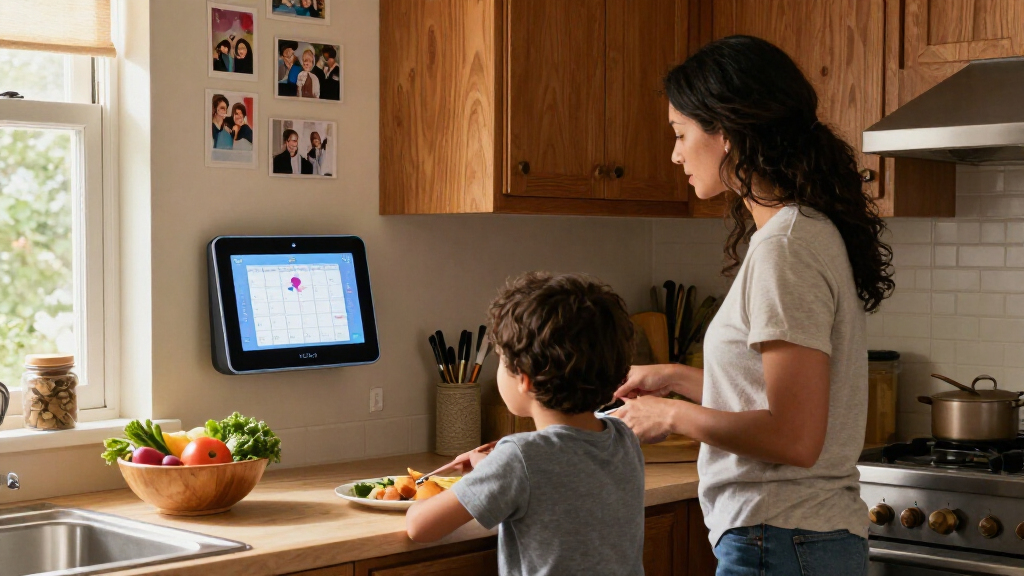
The devices are aimed at a different role from a conventional personal computer. The report describes a communal screen for household coordination—checking calendars, meal plans and grocery lists, viewing who is at the door, or adjusting connected lights and thermostats. They are not presented as replacements for a computer used for homework or bill payments.
The report identifies a hardware upgrade as a central change. Apple’s HomeView uses an A18 chip and Liquid Retina display; Amazon’s Echo Show 16 has a MediaTek processor and the same Nanomatte display used in Amazon’s new Alexa Tablet. The reviewer said the screens appeared more capable than earlier smart displays, but did not report completed performance testing.
The two products take different approaches to household use. Amazon’s device is designed to work as a household-centered screen without requiring a phone, although a phone can help with setup. HomeView is more closely tied to the iPhone: the report says it has some built-in apps and relies on a connected iPhone for others. Apple’s system may also use personal information and nearby-device or face recognition to provide more tailored features, according to the reviewer’s account of a company demo. For a closer comparison, see which smart display to buy.
The pitch addresses a familiar problem for families: calendars, shopping lists, meal plans and chores can end up concentrated on one person’s phone. A fixed, shared display could make household information easier for everyone to see and update, while also placing smart-home controls and camera views in a common location.
The potential value depends on the devices being straightforward to use. The reviewer highlights an always-on screen that can be tapped without entering a PIN or dismissing a screensaver, alongside the ability to switch between users. If those features work as described, the displays could serve as a day-to-day household interface rather than another voice-assistant gadget. That remains a possibility, not a demonstrated long-term result.
Price is a substantial qualification. The HomeView is $299, and the Echo Show 16 is $499.99. The report compares those prices with the $85 Echo Show 5 and $99 Nest Hub in 2023, underscoring the higher cost of the newer category. Buyers will need to judge whether the additional hardware and household features justify the expense.
Products Worth Considering

Sony BRAVIA 5 85-Inch Mini LED 4K HDR Smart TV (K-85XR50)

TCL QM64L 85-Inch QD-Mini LED 4K Smart Fire TV

Samsung 85-Inch QN70H Neo QLED 4K Smart TV (2026)
As an affiliate, we earn on qualifying purchases.
From Smart Displays to Home Hubs
The Verge reviewer says that three years earlier they had written an obituary for the smart-display category, describing available products as underpowered and spread across too many functions without doing any of them especially well. The new launches are framed as a response to those shortcomings, with stronger hardware and a clearer focus on shared household use.
The report also points to a gap that tablets have not fully filled. Tablets can offer a large screen, but the reviewer says multiuser support can be limited and portable devices may be taken away from the shared space or left without charge. The reviewer’s experience with Google’s Pixel Tablet, which combined tablet and smart-display functions, included concerns about its detachable screen and smart-home support. The article says Google reportedly canceled a successor 18 months later.
Products such as the Skylight Calendar have also shown demand for a dedicated household display, according to the report. HomeView and Echo Show 16 extend that idea by combining shared information with smart-home functions, but their different ties to personal phones and home-wide services may shape which households find them useful.
“These could finally turn the smart display into what it should have been all along: the family computer.”
— The Verge reviewer
Daily Use Still Needs Testing
The assessment is based on brief hands-on time, not extended testing in a household. It is not yet clear how reliably the displays handle multiple users, whether their interfaces remain convenient over time, or how well their smart-home features work across different devices and services.
Some of the most ambitious capabilities were shown in company demonstrations. Apple’s example involving messages, a visitor’s arrival and a coffee machine, and Amazon’s demonstration connecting driveway presence to a Ring camera view, should be understood as demonstrated scenarios, not independently verified claims about everyday performance. The report does not establish how much those functions depend on subscriptions, compatible products, account settings or specific privacy permissions.
It also remains unclear whether households will consider either product worth its price, particularly when cheaper displays or existing tablets may cover some of the same needs. The source report does not provide sales data, independent benchmarks or a final recommendation after extended use.
Extended Reviews Will Test the Promise
The next useful milestone is longer-term testing in real households. That should show whether each display can handle shared calendars and controls without making one person’s phone or account the center of the experience, and whether the devices remain accessible when several people use them.
Further evaluation can also clarify performance, compatibility, privacy settings and the practical limits of the companies’ demonstrations. Until that work is available, the confirmed development is the launch of two more expensive, more capable-looking smart displays; their success as family screens remains unproven.
Key Questions
What are the HomeView and Echo Show 16?
They are new smart displays from Apple and Amazon. The report presents them as shared household screens for tasks such as checking calendars, controlling compatible smart-home devices and viewing doorbell or camera information.
How much do the two displays cost?
Apple’s HomeView is priced at $299, while Amazon’s Echo Show 16 is priced at $499.99, according to the source report.
Do they replace a laptop or desktop computer?
No. The “family computer” description refers to a communal household screen, not a device for tasks such as homework or paying bills.
How do Apple and Amazon differ?
Amazon’s Echo Show 16 is designed to function as a household device without requiring a phone, though one can help with setup. HomeView is more closely tied to the iPhone and personal user information, and the report says some functions rely on a connected phone.
Have the devices been proven to work well for families?
No. The reviewer had only brief hands-on time and said proper testing was still needed. Longer-term performance, multiuser usability and the value for the price remain unclear.
Source: theverge.com